

System Architecture
Overview & Component Diagram
Origin is a hybrid on-chain/off-chain system. Latency-sensitive components (matching, risk evaluation, oracle ingestion) run off-chain. Custody, settlement, and the economic state of record run on-chain on Arc as smart contracts. The two layers are bound together by a settlement protocol that batches off-chain state transitions and commits them atomically.
Users always retain on-chain ownership of their collateral. The off-chain components have authority to update positions and balances only within constraints enforced by the on-chain margin contract: they cannot move collateral out of the system, increase a user's debt beyond posted collateral, or override the asset registry.
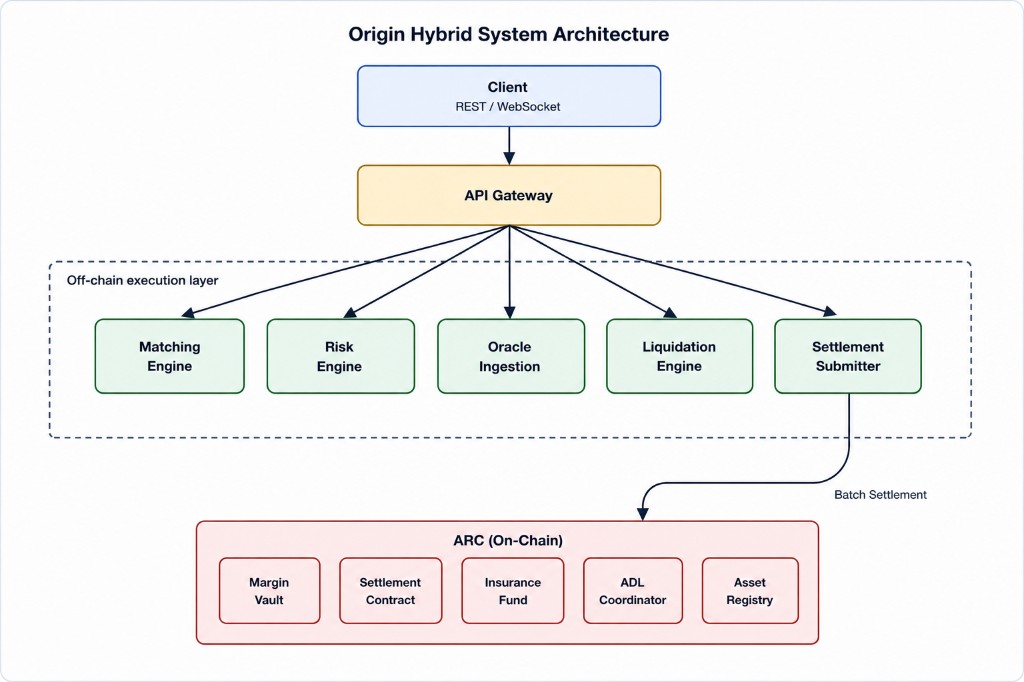
On-Chain Components
The on-chain footprint is a small, audited contract set:
| Contract | Responsibility |
|---|---|
| Margin Vault | Custody of all user collateral. Enforces solvency invariants on every state transition. |
| Settlement | Receives signed batches of fills from the matching engine and atomically applies them to user positions and balances. |
| Insurance Fund | Holds reserve capital. Pays keeper fees and absorbs liquidation shortfalls. |
| Asset Registry | Records accepted collateral, haircuts, oracle bindings, and listed markets. Updated only by governance. |
| ADL Coordinator | Records ADL events and applies them to selected counterparty positions. |
All contracts are upgradeable only through the published governance flow with a timelock.
Off-Chain Components
The off-chain components are operated by Origin and are designed for low-latency execution:
- Matching Engine. Maintains the order book per market, applies price-time priority, produces fills.
- Risk Engine. Evaluates each account's margin ratio on every mark-price update and every fill. Detects liquidation conditions.
- Oracle Ingestion. Pulls Pyth feeds for index prices. Polls configured external venues for the CEX price set used in mark price (Mark Price (Three-Source Median)).
- Liquidation Engine. Routes flagged accounts to the internal closeout flow first, then to public keepers if necessary.
- API Gateway. REST + WebSocket endpoints for clients. Authenticates, rate-limits, forwards.
- Settlement Submitter. Batches fills, funding payments, liquidations, and ADL events; submits them to the on-chain Settlement contract.
Order Flow
A typical limit order flows through the system as follows:
- Submission. Client signs and submits via REST or WebSocket to the API Gateway.
- Pre-trade checks. Gateway verifies authentication, rate limits, and order validity (symbol, side, size, price, flags).
- Risk check. Risk Engine confirms the account has sufficient initial margin to support the order if it fills.
- Book entry. Matching Engine accepts the order onto the book and assigns it a sequence number.
- Match. When a counterparty order arrives that crosses the resting order, the engine produces one or more fills.
- Mark-to-market. Risk Engine updates both accounts' positions and balances in working state.
- Batch. Settlement Submitter accumulates fills into the next on-chain batch.
- Commit. Batch is submitted to Arc; on finality (sub-second), on-chain state matches off-chain state.
- Confirmation. Client receives a fill notification via WebSocket and a settlement event when the batch finalizes on-chain.
Steps 1 through 7 happen in the off-chain hot path within single-digit milliseconds in the typical case. Steps 8 and 9 add Arc finality (sub-second). The full state machine governing order transitions is specified in Order Lifecycle State Machine.
Trust & Authority Model
The off-chain operator can:
- Match orders and produce fills.
- Compute funding rates and liquidation eligibility.
- Submit settlement batches.
The off-chain operator cannot:
- Move user collateral to addresses outside the Margin Vault.
- Take a user's balance below zero (the Margin Vault rejects any settlement that would).
- Modify the asset registry or any market parameter.
- Pause withdrawals of free collateral via the on-chain emergency exit path (Emergency Exit).
This split means the worst-case impact of off-chain operator failure or compromise is bounded: trading halts, but funds remain in the user's control on-chain.
Failure Modes
Origin is designed to fail safely. The following table summarizes the system's response to each major failure class. System-wide states and their transitions are specified in Operational States.
| Failure | System Response |
|---|---|
| Matching Engine outage | New orders rejected. Existing positions unaffected. Withdrawals of free collateral remain available. |
| Oracle feed stale | Affected market enters per-market HALTED; existing positions not liquidated until feed recovers (Oracle Heartbeat & Staleness). |
| Settlement Submitter outage | Trading continues briefly using the last committed state; if outage exceeds threshold, new fills paused until commitment resumes. |
| Insurance fund depleted | ADL triggers (Auto-Deleveraging (ADL)). |
| Arc network outage | Origin halts new deposits and withdrawals; existing positions continue marking; new fills paused. |
| Operator unresponsive past threshold | System auto-transitions to EMERGENCY_EXIT; users withdraw via on-chain path (Emergency Exit). |
Settlement Batching
Off-chain state changes are committed to Arc through batched settlement (Settlement Batch Structure specifies the batch structure). Each batch is signed by the Settlement Submitter and validated by the on-chain Settlement contract against the invariants of the Margin Vault. A batch that would violate solvency for any account is rejected atomically; no partial application.